Short answer
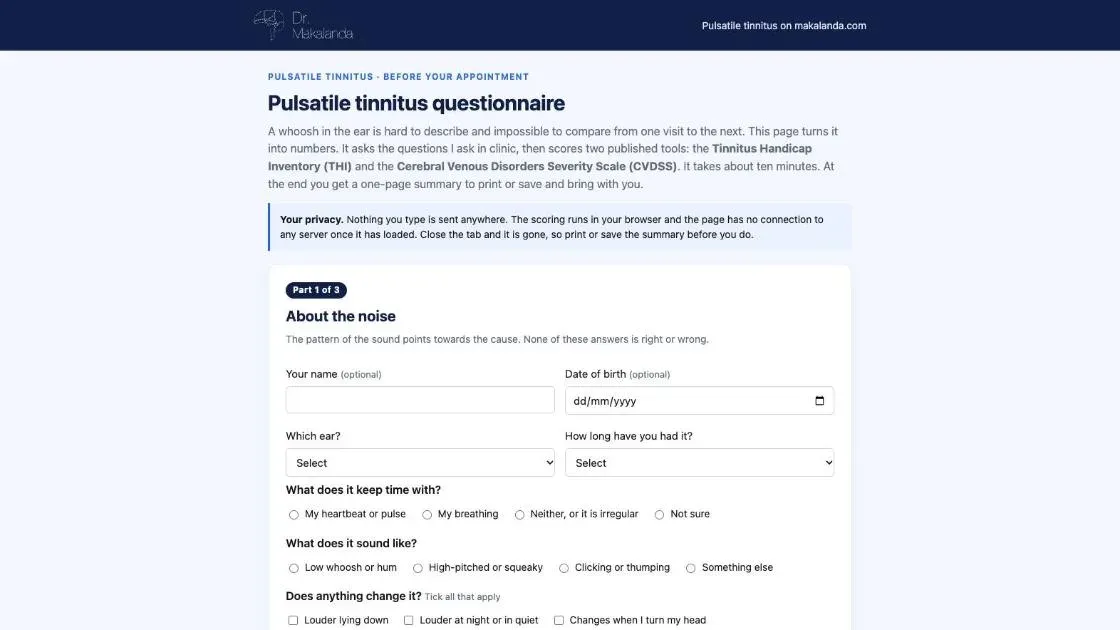
Pulsatile tinnitus is hard to describe and harder to compare from one visit to the next. I have put a short questionnaire online that does the describing for you. It asks the questions I ask in clinic, then scores two published tools: the Tinnitus Handicap Inventory, which measures how much the noise is affecting your life, and the Cerebral Venous Disorders Severity Scale, which captures the wider symptoms that travel with disorders of the veins draining the brain. It takes about ten minutes, runs entirely on your own device, and ends with a one-page summary to print or save and bring to your appointment.
Three things to take away
The scores are a baseline, not a diagnosis. They tell us how bad it is for you today. They do not tell us what is causing it, and a low score does not mean there is nothing to find.
Numbers make the follow-up honest. If you go on to have treatment, repeating the same questionnaire afterwards shows whether it worked, in your own figures rather than anyone’s impression.
Nothing you type leaves your device. The page has no server behind it. Close the tab and the answers are gone, so print or save the summary first.
Why I built it
Most people with pulsatile tinnitus have told their story many times before they reach me. GP, ENT, audiology, sometimes neurology. Each time the description is a little different, because a whoosh is a difficult thing to put into words, and because how bad it feels depends on what kind of week you have had.
That causes two problems. The first is that a good part of a consultation goes on inventory: which ear, how long, what changes it, who you have seen, what scans you have had. Useful, but it is time I would rather spend on what the findings mean for you. The second problem is bigger. If I cannot measure the symptom before treatment, I cannot honestly say afterwards whether treatment helped. “It feels a bit better” is not something either of us can build a decision on.
Clinicians who look after venous causes of pulsatile tinnitus have started using structured scores for exactly this reason. I wanted my patients to have the same tools, at home, before we meet.
What the questionnaire asks
It is in three parts.
Part one is about the noise itself. Which side, how long, whether it keeps time with your pulse or your breathing, whether it is a low whoosh or a high-pitched sound, and what changes it: lying down, turning your head, pressing on the neck, exercise. These patterns matter. A low, positional noise that quietens when you press on the side of your neck points towards the veins. A high-pitched noise that nothing changes points elsewhere. There is also space for the scans you have had and the clinicians you have already seen.
Part two is the Tinnitus Handicap Inventory, or THI. Twenty-five questions about how the noise affects concentration, sleep, mood, work and relationships. Each answer is yes, sometimes or no, and the total runs from 0 to 100. It was published by Newman and colleagues in 1996 and it is the most widely used tinnitus questionnaire in the world, which means your score can be compared with published series and with your own score later.
Part three is the Cerebral Venous Disorders Severity Scale, or CVDSS. Seven questions covering headache, concentration and memory, tinnitus, dizziness, visual symptoms, involuntary motor episodes and whether the symptoms have left you unable to work. It was proposed in 2025 by Fargen, Amans and Hui, three neurointerventionalists who treat venous disease, as a way of capturing the whole picture rather than the ear alone. The total runs from 0 to 23.
What the numbers mean
The THI has published grades. A score of 16 or under is grade 1, slight. Up to 36 is mild, up to 56 moderate, up to 76 severe, and anything above that is graded catastrophic. Those grades come from a British working group in 2001 and they describe impact on daily life, nothing more. Plenty of people with a treatable venous cause score in the mild range. Plenty of people with a high score have a cause that needs no procedure at all.
The CVDSS is newer. Its authors call it a preliminary scale, in use in clinics but not yet formally validated, and they give three bands: 0 to 5 mild, 6 to 12 moderate, above 12 severe. I treat those bands as a rough guide. What the scale does well is show the spread. Someone whose score comes almost entirely from the tinnitus item is a different patient from someone with the same total spread across headache, vision and brain fog, and the second pattern makes me think harder about pressure inside the head.
What the numbers do not mean
They do not diagnose anything. They do not decide whether you need a scan, and they do not decide whether you need treatment. Those decisions come from the history, the examination and targeted imaging, which I describe in my earlier article on pulsatile tinnitus. A high score is not a reason to be frightened and a low score is not a reason to be dismissed. The questionnaire is there to make the conversation sharper, not to replace it.
How to use it
Open the questionnaire, answer what you can, and press “Generate summary”. You will see your two scores, the answers that produced them and a table of everything from part one. Print it, save it as a PDF, or copy it as text into an email or a note on your phone. Then bring it. If you are coming to see me, send it ahead with your referral if you can.
Do it when you have a quiet ten minutes, and answer for a typical recent month rather than your best or worst day. If you later have treatment, do it again three months on. That second score is the one that tells us whether we got it right.
When to seek urgent advice
The questionnaire is for a symptom you have had for a while. It is not for emergencies. If the noise arrives suddenly with a severe headache, new weakness, difficulty speaking, loss of vision, or after a head or neck injury, call 999 or go to A&E. For anything else that worries you and cannot wait for a clinic appointment, call NHS 111.
A second opinion is reasonable
If you have been told your scans are normal and the noise is still there, a focused vascular opinion is a reasonable next step, and arriving with your scores makes that consultation more useful. For patients considering a second opinion, my website explains the process. The pulsatile tinnitus page describes the assessment pathway in more detail.
Frequently asked questions
Is my information stored anywhere?
No. The page runs in your browser and has no connection to a server once it has loaded. Nothing you type is sent to me or to anyone else. That is also why you need to print or save the summary before you close the tab.
What is a normal THI score?
There is no normal. The THI measures how much tinnitus is interfering with your life, so someone with no tinnitus would score 0. A score of 16 or under is graded slight. Most people who seek help score higher than that, and the grade says nothing about the cause.
Do I need to answer every question?
Answer what you can. The summary tells you how many questions were left blank and treats the total as a minimum. For the THI, a complete set of 25 answers is more useful because it can be compared with published figures.
Can I use it if my tinnitus is not pulsatile?
The THI was designed for all tinnitus, so that part is valid for anyone. The first part and the CVDSS are built around pulsatile tinnitus and the venous conditions behind it. If your tinnitus is a steady ring or hiss with no rhythm, an ENT or audiology assessment is the better starting point.
Should I repeat it?
Yes, if anything changes: after treatment, after a new scan, or if the symptom gets noticeably better or worse. Use the same questionnaire each time so the scores are comparable, and keep the summaries together.
This article and the questionnaire it describes are for general educational information and are not a substitute for personalised medical advice. The questionnaire does not diagnose any condition. If you have symptoms or concerns, please seek advice from an appropriately qualified clinician. For sudden severe headache, new neurological symptoms or symptoms after head or neck injury, seek urgent medical advice via NHS 111 or attend A&E.